
Living in Dubai as an expat means managing multiple currencies and frequent cross-border transfers. Most people start with a traditional bank account, but high fees and poor exchange rates can eat into every transaction. That is where exchange houses in Dubai come in.
Exchange houses offer a smarter way to move money. They combine competitive exchange rates with fast, regulated services that banks often cannot match. In fact, the UAE handles a massive share of global remittances through these institutions. According to the latest United Arab Emirates Remittances Market Data Overview, exchange houses processed a huge portion of the country’s outward remittances in recent years.
Why does this matter to you? Whether you are sending money home to family, paying for a property purchase, or running a business with international suppliers, every dirham counts.
Exchange houses help you keep more of your money by offering rates that are often much better than what your bank offers at the counter.
This guide covers everything you need to know about using exchange houses in Dubai for personal and business needs. We will look at how they work, what services they offer, and how to choose the right one for real estate transactions, daily remittances, and more.
If you are also exploring property investments in Dubai, understanding how money moves through exchange houses can help you plan your finances better. Pair that with professional advice from a trusted source, and you have a solid foundation for building wealth in the UAE. For a deeper look at how expert guidance fits into your property goals, check out our guide on financial advisor services for Dubai property investors.
And if you are ready to take the next step with your Dubai real estate journey, you can get a FREE Dubai Real Estate Consultation to discuss your options with someone who knows the market inside out.
What Are Exchange Houses and Why Do Expats in Dubai Use Them?
So what exactly is an exchange house? Think of it as a specialist shop for moving money. Unlike a regular bank that offers a bit of everything, exchange houses in Dubai focus on two main things: foreign currency exchange and international money transfers. They do these jobs every day, thousands of times, which makes them very good at it.
The big advantage comes down to cost and speed. Exchange houses offer exchange rates that are much closer to the real market rate than what banks usually give you. According to the World Bank report on key remittance trends, the average cost of sending money from the UAE is about 2.9 percent. That is roughly half the global average of 6 percent. For every 100 dirhams you send, you keep roughly 3 more dirhams in your pocket compared to sending from most other countries. Over a year of regular transfers, those savings add up fast.
Expats in Dubai rely on exchange houses for all kinds of payments. Sending money to support family back home is the most common use. But people also use them to pay for university tuition abroad, fund real estate purchases, and settle business invoices with overseas suppliers. The process is simple. You walk into a branch or log into the app, select your currency, and the money moves in hours or days instead of the week-long wait some banks require.
Dubai’s network of exchange houses is among the most advanced in the world. You will find hundreds of branches across the city, from busy main roads to quiet residential neighborhoods. And nearly every major exchange house now has a strong digital platform too. That means you can send money from your phone while sitting at home or waiting for your coffee.
If you are managing your finances for property investments in Dubai, understanding how exchange houses work helps you plan your cash flow better. For a deeper look at how to organize your overall financial picture alongside your real estate goals, check out this guide on Dubai wealth management and financial planning for property investors.
Regulation and Trust: How Exchange Houses Are Overseen in Dubai
You might be wondering: is my money safe with an exchange house in Dubai? That is a smart question. The short answer is yes, and here is why.
Dubai’s exchange houses do not operate in a free-for-all environment. They answer to the UAE Central Bank, which sets strict rules for how they must run. Every single exchange house in the country needs a license from the Central Bank to operate. Without that license, they cannot accept a single dirham for transfer.
The Central Bank does not just hand out licenses and walk away. It audits exchange houses regularly. It checks their books, their records, and their security systems. If a house fails to meet the rules, it can lose its license or face heavy fines.
One of the biggest requirements is anti-money laundering (AML) compliance. Exchange houses must verify who you are before they process your transfer. They need a copy of your passport, your Emirates ID, and sometimes proof of where the money comes from. This is called Know Your Customer (KYC) protocol. It might feel like a hassle when you are in a hurry. But it is actually a layer of protection for you and for the whole financial system.
The Central Bank also requires exchange houses to keep a minimum amount of capital on hand. This ensures they have enough cash reserves to cover customer transactions even during tough times. In June 2025, the Central Bank introduced updated Exchange Business Regulations that raised these standards even higher. You can read more about these rules in the official Exchange Business Regulation from the CBUAE Rulebook.
For property investors, knowing that your money transfer partner is regulated by a strong central bank gives you peace of mind.

It means your funds move through a system designed to protect you. When you eventually work with professionals to plan your real estate investments, you will want that same level of trust. That is why choosing a fiduciary financial advisor for property investors is just as important as picking a regulated exchange house.
So the next time you use an exchange house in Dubai, remember that the Central Bank has your back. That small extra verification step when you send money is part of a much bigger safety net.
Exchange Houses vs. Banks: A Detailed Comparison for Expat Transfers
So you have two main options when sending money as an expat in Dubai. You can use a traditional bank or an exchange house. The difference in what you actually get matters a lot.
Let me walk through how they compare.
Cost and exchange rates
Banks make money in two ways on international transfers. First, they charge a flat fee, often around 30 to 50 dirhams per wire. Second, they give you a worse exchange rate than the real market rate. This hidden markup is called the spread. It can easily cost you another 2 to 5 percent on top of the fee.
Exchange houses in Dubai work differently. They compete on rates because that is their core business. Most charge no fee or a very small one. Their exchange rates are much closer to the mid-market rate you see on Google. For popular corridors like sending dirhams to India, the Philippines, or Pakistan, the rate difference can save you hundreds of dirhams on a single transfer.
Speed
An international wire from a bank can take 3 to 5 business days. Sometimes longer if it goes through correspondent banks in between. The money moves slowly through a chain.
Exchange houses are faster. Many offer same-day transfers for common routes. Your recipient in India can have rupees in their account within hours, not days. This speed matters when you are paying a property deposit or closing a deal on a rental.
Convenience
Banks require you to visit a branch or use their app. If you have an SBI account opening online already set up, you might find their app convenient for local use. But for international transfers, the process is often clunky. You fill out forms, wait for approvals, and track the wire through a system that is not always clear.
Exchange houses have physical branches all over Dubai. You walk in, show your passport, fill a short form, and hand over the cash or debit card. Many also offer online platforms now. The whole thing takes 10 to 15 minutes.
A quick comparison table
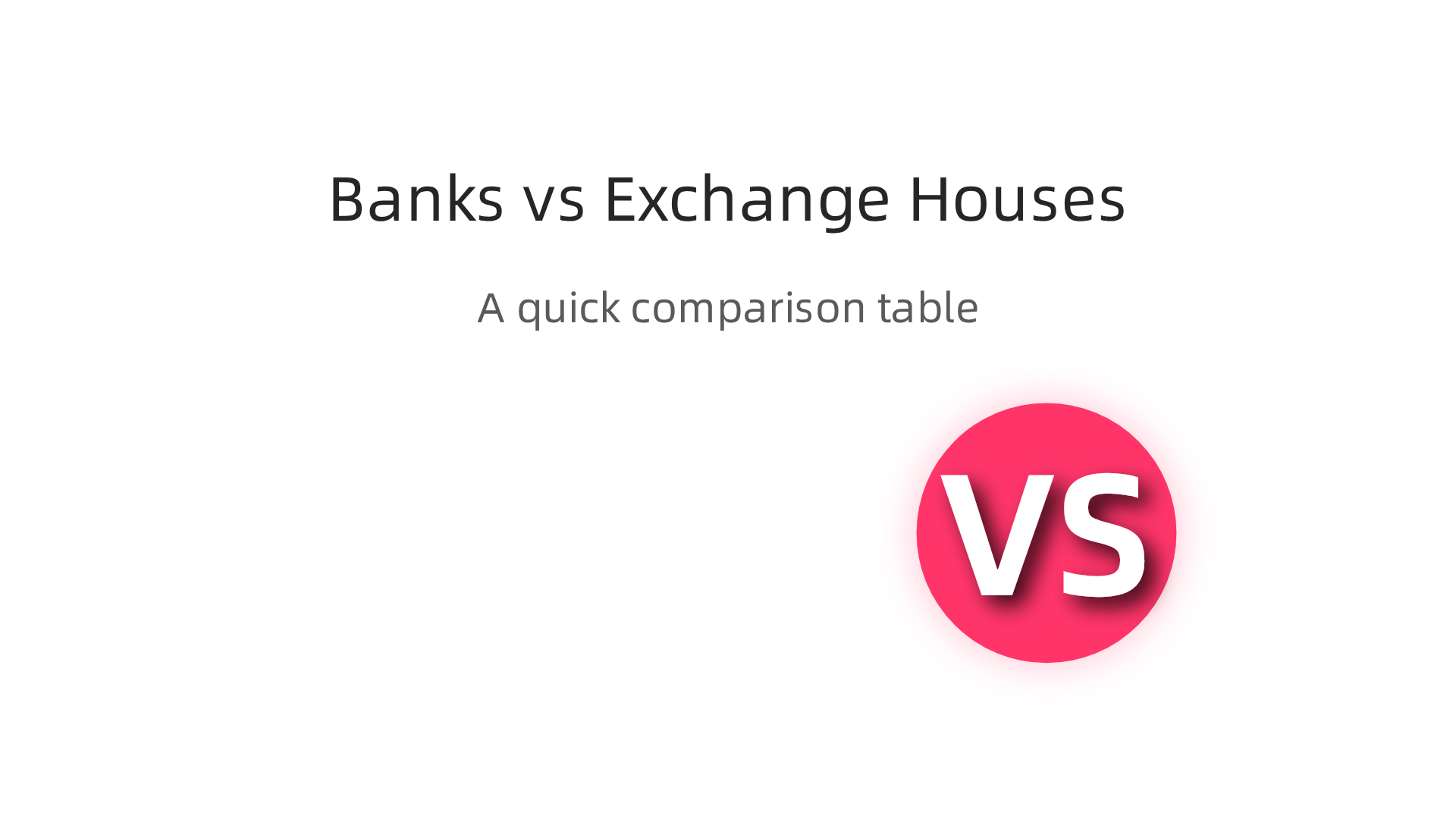
| Feature | Banks | Exchange Houses |
|---|---|---|
| Transfer fees | 30 to 50 AED or more | Zero or very low |
| Exchange rate markup | 2 to 5 percent | Close to market rate |
| Transfer time | 3 to 5 business days | Same day for popular routes |
| Paperwork | Branch visit or online forms | Walk in with ID, done in minutes |
| Regulation | UAE Central Bank | UAE Central Bank |
Which one should you choose?
For small, regular transfers like sending money home to family each month, an exchange house wins on cost and speed every time. For very large transfers over 100,000 dirhams, a bank might feel safer to some people, but even then, regulated exchange houses in Dubai are backed by the same Central Bank oversight. The recent updates to the CBUAE rulebook on exchange houses show how seriously the system takes security.
If you are a property investor who needs to move money regularly for down payments or rental income, exchange houses give you better value. Once the money arrives, you will also want to manage it wisely. That is where understanding your options for banking services for Dubai property investments becomes useful.
The bottom line is simple. For most expat transfers, exchange houses deliver more dirhams to your recipient in less time. Banks are fine for domestic use and large institutional wires, but they are rarely the best choice for sending money abroad.
Top Exchange Houses in Dubai for 2026: Services, Rates, and Reputation
So once you decide an exchange house is your best bet, the next question is which one to pick. Dubai has a lot of them. But a few names keep coming up because they are reliable, fast, and offer great rates.
Let me walk you through the top exchange houses in Dubai for 2026.
Al Ansari Exchange
This is probably the most well known name. Al Ansari Exchange has been around since 1966 and now has more than 115 branches across Dubai. You can find one in almost every neighborhood. They handle everything from personal remittances to corporate payments. Their rates are consistently competitive, and their staff are trained to process transfers quickly. If you want a safe bet with a huge branch network, this is a strong choice. The Visit Dubai guide on where to exchange money in Dubai lists them as one of the most trusted exchanges in the region.
UAE Exchange
Now part of the Finablr group, UAE Exchange is another giant in the space. They offer both walk in services and a solid online platform. For expats who want to manage transfers from their phone, their app is easy to use. They cover a wide range of currency pairs, including popular corridors to South Asia and the Philippines. Check out the UAE Exchange reviews on Trustpilot to see what real customers say about their service and speed.
Lulu Exchange
If you shop at Lulu hypermarkets, you have probably seen their exchange counters. Lulu Exchange is known for being fast and straightforward. They are especially strong for sending money to India, Pakistan, Bangladesh, and Sri Lanka. Many expats use them for monthly family remittances because the rates are good and the transfer is often completed within hours.
Al Fardan Exchange
Al Fardan Exchange focuses on both retail and corporate clients. They have a reputation for handling larger transfers smoothly. If you are moving money for a property deposit or a business deal, their team can guide you through the process. They also offer online booking for better rates if you reserve your transfer ahead of time.
Other reliable names
City Exchange has been operating since 1997 and is known for reliable service. You can find their details on the City Exchange UAE website. Salim Exchange, established in 1989, is another regulated option. The Salim Exchange site shows their range of services. For those who prefer digital first solutions, Mesrkanloo International Exchange and Al Dahab Exchange also have strong online platforms and competitive rates.
How to pick the right one for you
Your choice depends on what matters most. For speed on common routes, Lulu Exchange or Al Ansari are great.

For online convenience, UAE Exchange works well. For very large transfers, Al Fardan or Salim Exchange might be a better fit.
Once you have your money in the right place, the next smart step is to put it to work. A good financial advisor for Dubai property investors can help you turn that transferred cash into a rental income stream.
The key is to pick one exchange house you trust and stick with them. You will get better rates as a repeat customer.
How to Use Exchange Houses for Large Transactions, Including Real Estate
Let’s say you found the perfect apartment in Dubai Marina. The price is right, the view is stunning, and your dream of owning a home here feels real. Now you need to move a big chunk of money from your home country to Dubai for the down payment. How do you do that without losing a small fortune in bad exchange rates?
Exchange houses are not just for sending 500 dirhams to family. They are also built for large transactions like property purchases. Many of the exchange houses we talked about offer special services for high value transfers. These include faster processing, lower fees, and even a dedicated relationship manager who can handle your transfer from start to finish.
The smart way to move six figures
If you are transferring a large amount like a property down payment or the full purchase price, here is what you should do.
First, contact the exchange house ahead of time. Do not just walk in. Call or email their corporate team. Tell them the amount you are sending and the currency pair. They will often give you a better rate than the standard counter rate. For example, the team at Orient Exchange can quote you a preferential rate for large amounts.
Second, plan the timing of your transfer. Exchange rates move every day. If your property closing is in two months, you do not have to wait until the last day. You can use something called a forward contract. This locks in a good exchange rate today for a transfer that will happen in the future. It protects you if the rate gets worse before your closing date.
Third, keep all your paperwork ready. Large transfers need extra checks. The exchange house will ask for your passport, proof of where the money came from, and your property sale agreement. Having these documents ready speeds up the whole process.
How to pick the right exchange house for a big transfer
Not every exchange house treats large transfers the same. Some focus on small remittances. Others have a whole team for corporate and high value clients. Al Fardan Exchange and Salim Exchange both have good reputations for handling larger sums smoothly.
Once your money arrives in Dubai and your property deal is done, you will want to make sure that investment works for you. Smart investors think ahead. They plan how to manage that rental income and grow their wealth over time. That is where getting the right advice helps. You can read our personal financial planning tips for Dubai property investors to start building your long term strategy.
One more thing
If you are serious about buying property in Dubai and want to talk through the whole process from moving money to closing the deal, a free conversation with an expert can save you a lot of guesswork. FREE Dubai Real Estate Consultation — connect with Ayaz Salman to get clear, no pressure guidance for your property journey.
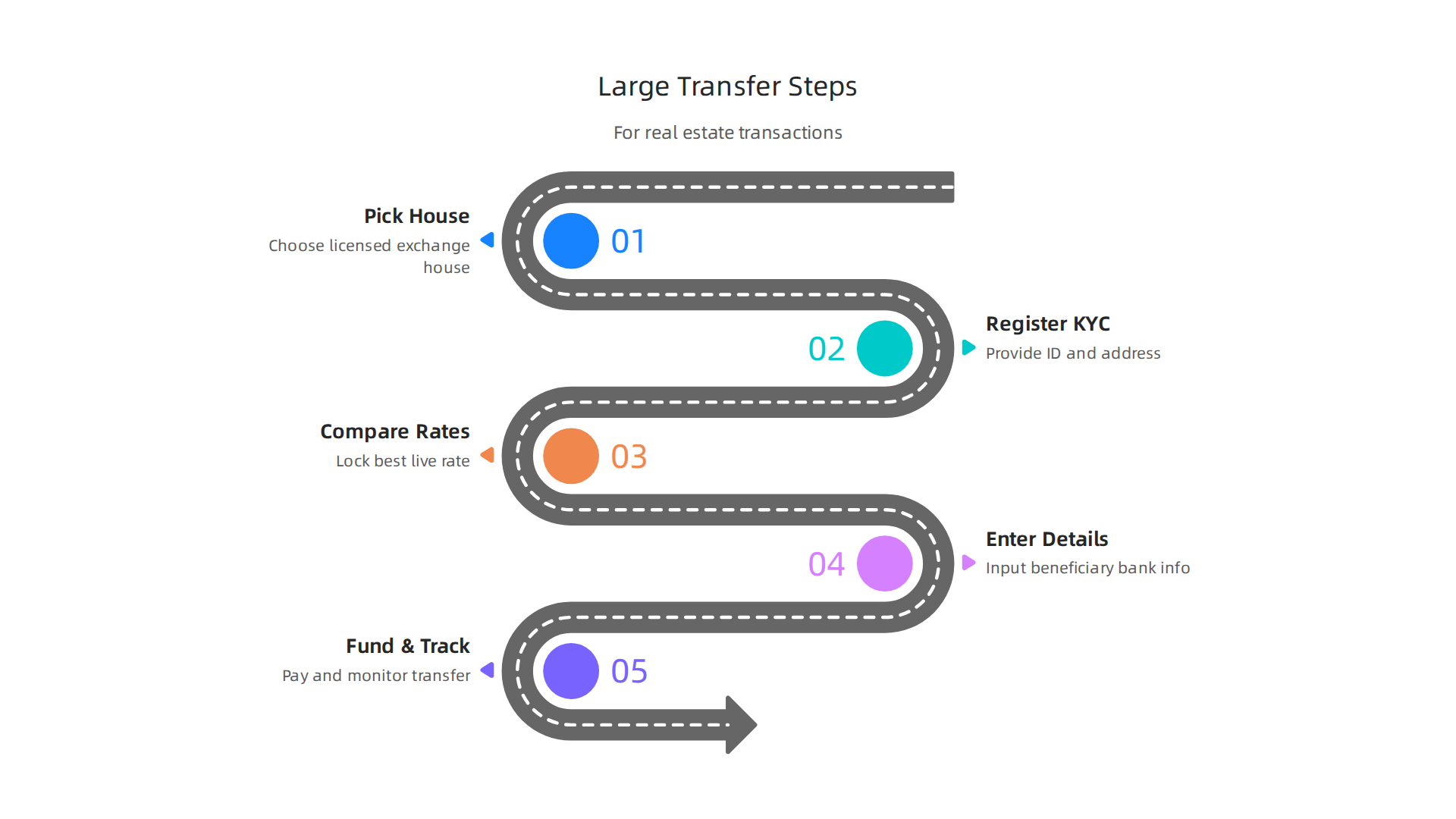
Step-by-Step Guide to Your First Transfer via an Exchange House
If you have never used an exchange house before, the process might feel a bit unfamiliar. But it is actually quite simple. Once you know the steps, sending money to or from Dubai becomes something you can do in minutes from your phone.
Here is how your first transfer works from start to finish.
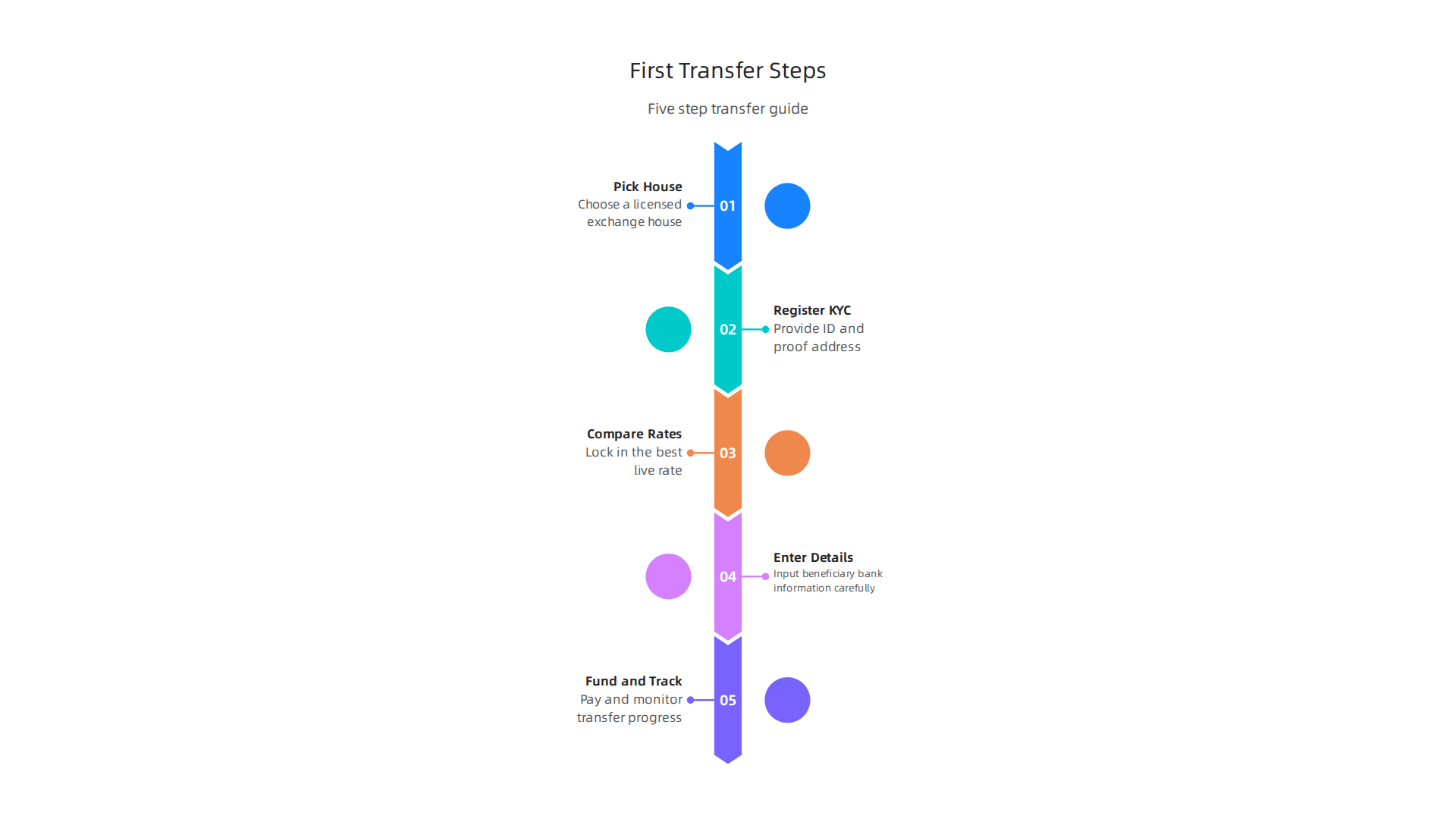
Step 1: Pick a licensed exchange house
Stick with exchange houses regulated by the UAE Central Bank. This keeps your money safe and ensures fair treatment if something goes wrong. The exchange houses we covered earlier are all good places to start.
Step 2: Register and complete KYC
Every exchange house needs to know who you are. This is called KYC or Know Your Customer. You will provide your passport, Emirates ID if you have one, and proof of address. Most exchange houses let you do this online now. You upload your documents through their app or website, and the approval takes a few hours. If you are new to Dubai and still setting up your life here, the HSBC checklist for moving to the UAE has helpful details on what documents you will need for various financial services.
Step 3: Compare live rates and lock one in
Here is where you save money. Do not just accept the first rate you see. Open two or three exchange house apps and compare their rates side by side. The difference between them can be significant on a large transfer. Once you find the best rate, you can lock it in right there in the app. The rate stays fixed until your transfer goes through.
Step 4: Enter the transfer details
Type in the amount you want to send. Choose the currency pair. Enter the beneficiary’s bank account details. This is the step where being careful matters most. Double check every digit of the bank account number and the IBAN. One wrong number and the money could go to the wrong place. Exchange houses also let you store beneficiary details for future transfers so you do not have to type them again.
Step 5: Fund the transfer and track it
You can pay using a bank transfer from your account, a debit card, or cash at the exchange house branch. After that, you get a confirmation with a tracking number. Most exchange house apps update you in real time as the money moves from their account to your beneficiary’s account. You will see each stage of the journey.
One more tip for first timers
Always check the city and bank branch details for the beneficiary. Some countries have multiple branches of the same bank, and the money might get held up if the branch code is wrong. A quick phone call to your recipient to confirm their full bank details saves a lot of headaches.
Once you get comfortable with this process, moving money becomes just another routine task, like checking your email or paying a utility bill. And if you are sending money specifically to buy property in Dubai, you can explore more about how to structure that investment by reading our guide on rent to own in Dubai without a full deposit.
Common Pitfalls and How to Avoid Them When Exchanging Currency
Even after you master the basic steps of using exchange houses, a few common mistakes can cost you real money. Here are the biggest ones expats run into and how to sidestep them.
Mistake 1: Not comparing rates across multiple exchange houses
The easiest way to lose money is to use the first exchange house you open. Rates between exchange houses in Dubai can vary by a surprising amount, especially on larger transfers. Do not assume all exchange houses offer the same deal.
Fix: Check at least three apps side by side before you send anything. The few minutes it takes could save you enough to cover a nice dinner out.
Mistake 2: Overlooking the hidden fees hiding in the spread
Here is a trick that catches many newcomers. An exchange house might advertise "zero fees" but build a fat margin into the exchange rate itself. This is called the spread. A bad spread can cost way more than a small upfront fee.
Fix: Compare the final amount your recipient will receive, not just the advertised rate or fee. That total number tells you the real story.
Mistake 3: Using airport exchange kiosks
Airport kiosks are the most convenient option in the moment. They are also the most expensive. The rates at Dubai airports are almost always worse than what you get from a proper exchange house in the city. This is the price you pay for convenience.
Fix: Plan ahead. Exchange a small amount at the airport only if you need cash immediately. Do all major transfers through a licensed exchange house. For more general advice on settling into Dubai life as an expat, the living in Dubai guide for expats has helpful tips on everything from banking to accommodation.
Mistake 4: Falling for scams promising unrealistic rates
Social media is full of too-good-to-be-true offers. Someone claims they can give you a rate far better than any exchange house. This is almost always a scam. Once your money is gone, it is gone.
Fix: Only use exchange houses regulated by the UAE Central Bank. If a rate seems unrealistically high, trust your gut and walk away.
The simple checklist that eliminates most problems
Our experience shows that adopting a simple four-step checklist fixes nearly every issue.
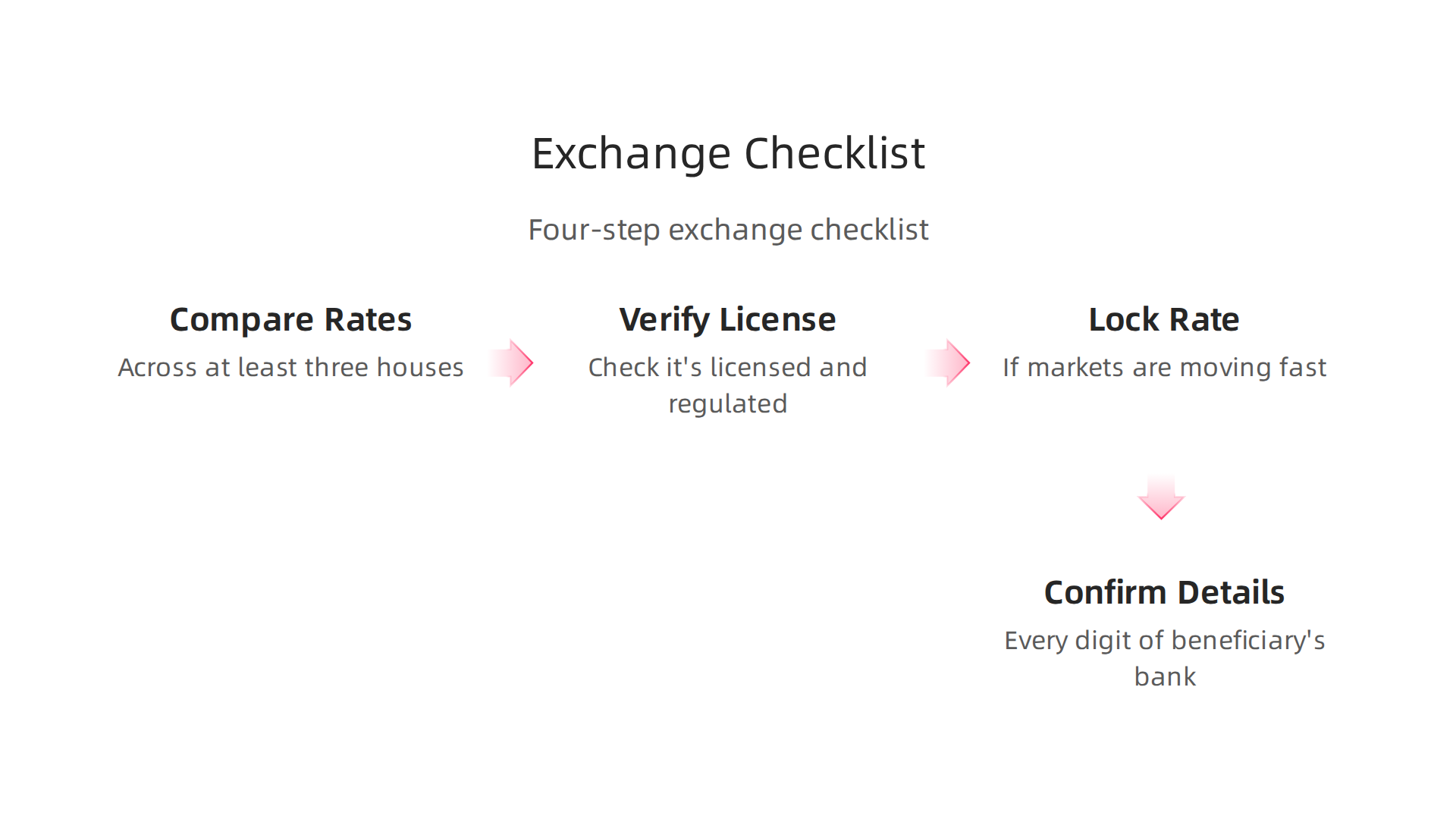
Before any transfer, do this:
- Compare rates across at least three exchange houses
- Verify the exchange house is licensed and regulated
- Lock the rate if markets are moving fast
- Confirm every single digit of the beneficiary’s bank details
Stick to these four steps and you will avoid the vast majority of headaches. And once your money is moving smoothly, you might turn your attention to what you came to Dubai for in the first place. If property investment is your goal, learning how a financial advisor for Dubai property investors builds your wealth can help you make that transfer work even harder for you.
The Future of Exchange Houses in Dubai: Digital Disruption and Fintech
The money exchange game in Dubai is changing fast. Fintech apps like Revolut and Wise are entering the market, and they are pushing traditional exchange houses in Dubai to level up their own services.

Dubai has a big target here. The city wants 90% of all transactions to be digital by 2026. That goal is part of the broader Dubai’s Cashless 2026 Strategy, and it is already reshaping how exchange houses work.
Big names like LuLu Exchange and Al Ansari Exchange are not sitting still. They are rolling out mobile apps, adding online booking tools, and forming partnerships with banks so customers never have to wait in line. This shift earned some of them a spot on Forbes’ list of top GCC exchange houses going digital, which shows how serious the industry is about change.
Then there is blockchain. Stablecoins and other digital assets promise cheaper, faster cross-border payments. But the rules around them are still taking shape. The UAE is working on clearer guidelines for digital currencies, and that will decide how big a role these technologies actually play.
For expats and property investors, this competition is good. More options mean better rates, faster transfers, and less hassle. The old days of standing in long queues are fading. Instead, you get the speed of a fintech app with the trust of a regulated exchange house. As digital banking and property transactions become more connected, you might also want to explore how fab online banking for Dubai property investors fits into this bigger picture.
Summary
This article explains why exchange houses are often the smarter choice for expats in Dubai who need to move money across borders. It covers what exchange houses do, how they are regulated by the UAE Central Bank, and why their exchange rates and speed typically beat traditional banks for remittances and real estate transactions. You’ll find a clear comparison of costs, speeds and convenience, a list of the top local providers in 2026, and practical steps for completing your first transfer. The guide also explains how to handle large property payments—when to call ahead, use forward contracts, and prepare documents—and highlights common pitfalls to avoid. Finally, it looks at digital disruption from fintech and what the future of cross‑border payments in Dubai may bring. After reading, you’ll know how to pick a licensed exchange house, save on fees, and move funds securely for everyday needs or property investment.