

Moving to Dubai is exciting. The skyline, the tax benefits, the lifestyle. It all feels like a win. But here’s the thing. Many expats and high net worth individuals jump into real estate or lifestyle spending without a solid plan. They get fragmented advice from different sources and end up missing key opportunities.
Dubai is not like other cities. Its economy, visa rules, and property market are all connected. That means your budgeting, investments, and real estate choices need to work together. A separate bank account here and a property purchase there is not enough. You need real personal financial planning tips that cover the full picture.
The biggest risk is treating money and property as two separate worlds. When you do that, you often miss tax savings, ignore currency risks, or buy a property that does not fit your long term goals. A unified approach including smart diversification and clear goals builds lasting wealth.

This guide walks you through the financial planning advice that works for Dubai’s unique setup. We will look at budgeting, smart investing, property market insights, and when to work with a chartered financial advisor.
If you are ready to take the next step, connect with Ayaz Salman for a free Dubai real estate consultation to start building your strategy today.

Step 1: Assess Your Current Financial Health Before Investing in Dubai Real Estate
You would not build a house without checking the foundation first. The same applies to buying property in Dubai. Too many expats skip this step. They see a shiny off-plan tower or a high-yield villa and jump in without knowing where their money really stands.
That is how people end up cash‑poor and stressed. Before you even think about a down payment, you need a clear picture of your net worth, your monthly cash flow, and your personal risk tolerance.

These three numbers are the ground you build everything on.
Start with a simple financial health checklist. Write down:
-
Your net worth – everything you own minus everything you owe. Include your home‑country debts like mortgages, student loans, or car payments. A study on why most expats fail at long‑term financial planning in Dubai shows that ignoring debt back home is one of the biggest mistakes people make.
-
Your monthly cash flow – the real money left after all expenses. Not what you hope to save. The actual number. Many expats suffer from cash flow blindness, spending too much on lifestyle and forgetting to track where the dirhams go.
-
Your liquidity needs – how much cash do you need for emergencies? At least three to six months of expenses in a savings account. Dubai has no unemployment benefits. If you lose your job or your visa changes, that emergency fund is your safety net.
-
Your currency exposure – if your income is in AED but you have debts in USD or GBP, exchange rate shifts can hurt you. Many expats overlook this risk when allocating money to Dubai property.
Once you know these numbers, you can set realistic goals. Do you want capital growth or rental yield? How much can you put down without draining your emergency fund? How long can you hold the property if the market dips?
This is where solid financial planning advice makes a difference. If you feel unsure about your numbers, it helps to talk to someone who looks at the whole picture. A professional can help you see gaps you missed and structure your move into the market safely. That is exactly what a good chartered financial advisor does. They connect your personal finances to your real estate strategy so you never buy more than you can handle.
For a deeper look at how an advisor can guide your property decisions, check out what a financial advisor can do for your Dubai property plans. It explains how an expert review of your finances before investing can save you from costly mistakes later.
Step 2: The Strategic Role of Real Estate in a Diversified Portfolio
It can be tempting to go all-in on Dubai property. The rental yields here are hard to beat. But smart investors know that putting every dirham into one asset class is risky. Real estate works best when it is part of a larger, balanced portfolio.

Dubai property can give you steady cash flow, long-term price growth, and protection against inflation. But only if the size of your real estate holding fits your overall wealth. A useful personal financial planning tip is to treat Dubai real estate like any other investment bucket. You want it alongside stocks, bonds, and maybe alternative assets, not instead of them.
What returns can you expect? As of 2026, rental yields in Dubai run from about 6% to 8% in many areas, with some communities offering even higher numbers. The Dubai real estate market analysis for 2026 shows that high rental yields remain a strong draw for investors. Compare that to major cities like London or New York, where yields often sit below 4%. That difference makes Dubai a powerful component of a global property portfolio.
But diversification goes beyond asset class. Within your real estate holdings, spread your money across different property types like apartments, villas, and townhouses. Mix different neighborhoods too. Some areas focus on high rental income, while others offer stronger long-term price growth. Combining short-term and long-term rental strategies can also reduce risk when the market shifts.
Here is a key financial planning advice principle: every investment in your portfolio should have a clear job. Does this property cover your monthly expenses? Does it build your net worth through appreciation? Is it a place for you to live while gaining equity? When you define the job, you avoid buying the wrong property out of hype. A chartered financial advisor can help you calculate exactly how much of your net worth belongs in Dubai real estate based on your goals and risk tolerance.
For a practical roadmap, check out this guide to buying rental properties in Dubai in 2026. It walks you through the steps of finding, financing, and selecting properties that match your diversification strategy.
If you want to see how Dubai real estate fits into your personal portfolio, you can get a FREE Dubai Real Estate Consultation. Talking with someone who understands both the local market and the big picture of wealth management can save you years of trial and error. Connect with Ayaz Salman to discuss your specific situation.
Asset Allocation Models for HNWIs and Expat Investors
You have built up savings or received a windfall. Now you need to decide how much goes into Dubai property. A good rule of thumb for many high net worth individuals and expats is to keep 15% to 25% of their total investment portfolio in real estate. This range gives you the cash flow and growth potential of property without putting all your eggs in one basket.
But the right number depends on your personal goals. If your main target is steady monthly income, you will tilt your real estate holdings toward high-yield rental properties. Areas like Jumeirah Village Circle or Dubai Marina consistently deliver gross yields of 6% to 8% or more, according to the latest rental yield analysis for Dubai in 2026. An income focused investor might put most of their 15-25% allocation into these kinds of assets.
If your goal is long-term wealth growth, you will focus on capital appreciation zones. Think of neighborhoods with strong price growth potential like Dubai Hills Estate or Palm Jumeirah. In that case, you might accept lower rental yields now in exchange for bigger price gains over the next five to ten years.
Here is a key piece of financial planning advice: whatever allocation you choose, you must rebalance regularly. Property values rise and fall. Over time, your real estate slice can grow too large or shrink too small compared to the rest of your portfolio. Rebalancing once a year helps you stay aligned with your risk tolerance and prevents market swings from controlling your financial future.
For expat investors especially, integrating Dubai property with your overall wealth plan takes careful thought. Your home country tax rules, retirement timeline, and exit strategy all matter. A good next step is to learn more about expat retirement planning and property in Dubai to see how these pieces fit together.
If you are unsure where to start, working with a chartered financial advisor who understands both global portfolios and the Dubai market can save you from costly mistakes.
Step 3: Navigating the Dubai Property Market – Key Considerations for Investors
Once you have decided on your asset allocation, it is time to get into the details of the Dubai market itself.
This step can feel overwhelming, but breaking it down into a few smart moves makes it manageable.
First, understand freehold versus leasehold zones. Freehold areas let you own the property and the land completely. Most international investors focus here. Leasehold zones give you rights for up to 99 years but you do not own the land. Popular freehold areas include Dubai Marina, Palm Jumeirah, and Jumeirah Village Circle. These locations tend to offer strong rental yields and solid capital growth potential, as shown in the latest United Arab Emirates’ Residential Property Market Analysis 2026.
Next, think about off-plan versus ready properties. Off-plan means buying before construction finishes. You often get a lower entry price and flexible payment plans. But you also take on development risk. Ready properties let you see exactly what you get and start earning rental income right away. Many first-time investors prefer ready units for that reason.
Another smart move is to focus on emerging growth corridors. Areas near new infrastructure projects or population hubs often outperform older neighborhoods. The 2026 outlook for Dubai homes from Gulf News highlights how connectivity and population growth drive long-term value.
Due diligence on the developer matters a lot here. Always check their track record. Look at how many projects they have completed on time. Read reviews from other buyers. A developer with a strong history reduces your risk significantly.
Market timing is less important than getting the fundamentals right. Dubai’s property market is powered by steady population growth, ongoing infrastructure spending, and a stable regulatory environment. These factors support prices over the long haul even if short-term fluctuations happen.
For a deeper look at the practical steps involved, check out this guide to buying rental properties in Dubai. It walks you through the process from start to finish.
If you are feeling unsure about any of these decisions, that is normal. Talking to someone who knows the local market inside and out can save you time and money. You can get a FREE Dubai Real Estate Consultation with a professional who understands both the numbers and the neighborhoods.
Legal Framework, Tax Efficiency, and Investor Residency
Understanding the legal and tax side of things is a big part of solid personal financial planning tips for Dubai property investors. The good news? Dubai offers zero personal income tax. That means no tax on your rental income or capital gains here. But you still need to think about Value Added Tax (VAT) on certain property services and, more importantly, your home country’s tax rules. Many countries tax their citizens on worldwide income, so a chartered financial advisor can help you structure everything properly.
For many investors, the biggest draw is the chance to secure long-term residency through property. The UAE Golden Visa offers a 5 or 10 year renewable residence visa for property investors. The main requirement is a minimum property investment of AED 2 million. The property must be completed, in a freehold zone, and registered with the Dubai Land Department. You also need to hold the investment for at least two years. You can learn more about the specific requirements from the official UAE Golden Visa guide provided by the government.
If you are looking at a shorter option, Dubai recently updated its two year investor visa rules. In April 2026, the Dubai Land Department removed the minimum property value requirement for sole owners. This means if you own a property by yourself in Dubai, you can now apply for the two year residence visa no matter what the property is worth. For jointly owned properties, each owner still needs a minimum share of AED 400,000. These changes are part of Dubai’s broader push to attract more international investors, as detailed in KPMG’s analysis of the revised visa rules.
Legal due diligence matters just as much as the visa paperwork. Always check the title deed with the Dubai Land Department before buying. Use escrow accounts for off-plan purchases to protect your money. And think about your ownership structure. Holding property in your own name is simplest, but some investors use a company structure for estate planning or privacy. A fiduciary financial advisor in Dubai can walk you through which option fits your situation best.
All of this might sound like a lot, but getting the legal and tax pieces right from the start saves you headaches later. If you want a clearer picture of how these rules apply to your specific plans, a free chat with someone who knows the Dubai market well can help. You can get a FREE Dubai Real Estate Consultation with an expert who understands both the numbers and the legal side of investing here.
Step 4: Managing Investment Risks and Optimizing Your Returns
No investment comes without risks, and Dubai real estate is no different. The smartest investors do not ignore those risks. They plan for them. That is where solid personal financial planning tips really pay off.
Here are the main risks to watch for in 2026:
Market downturns. Dubai property prices can shift based on global economic conditions and interest rates. As one detailed guide on risks in Dubai real estate and how to avoid them points out, focusing on long-term growth areas and established communities helps reduce your exposure to market swings.
Avoid buying based on hype alone. Do your research first.
Tenant defaults and vacancies. Your rental income can take a hit if a tenant stops paying or you face a long empty period. Pick properties in high-demand areas near metro stations and business hubs. Professional property management also helps keep your occupancy rate strong.
Currency volatility. If you earn income in a different currency than the UAE dirham, exchange rate changes can affect your actual returns. This matters more for international investors sending money in or out of Dubai.
Regulatory changes. The UAE government supports investors, but rules can evolve. Staying informed about new policies is your best defense. The Dubai Land Department and RERA keep things transparent, but you should still pay attention.
Stress-test your plan
A good financial planning advice habit is to run stress tests on your numbers. Ask yourself questions like these: What happens if interest rates go up by 2%? What if your property stays empty for six months? What if service charges increase more than you expected? If the numbers still work under those conditions, you are in a strong position. If they do not, you might need to adjust your approach before you buy.
Have a clear exit strategy
Smart investors think about the end before they begin. How long do you plan to hold the property? When is the best time to sell based on market cycles? How will you move your money out if you are an international investor? Having clear answers to these questions is part of strong personal and financial planning.
A chartered financial advisor who knows the Dubai market can help you build these stress tests and develop your exit strategy. They understand both the local real estate landscape and how it connects to your bigger financial picture. If you want to understand what a professional like that actually does, check out this guide on what a financial advisor does for Dubai property investors.
The 2026 market rewards investors who are strategic, not emotional. Buy the right asset for your specific goal, know your risks, and have a plan for every scenario. That is how you protect your capital and make it work for the long haul.
Rental Income Strategies for Landlords
Turning your Dubai property into a steady income stream takes more than just buying and handing over the keys. Smart personal financial planning tips help you get the most out of every square meter. Here are three proven approaches for 2026.
Focus on net yield, not gross rent. It is tempting to set rent high and hope for the best. But a smarter move is to price competitively to attract good tenants quickly. Every empty month eats into your returns. Keep your property well maintained and fix small issues fast. This reduces long term costs and keeps tenants happy. Happy tenants renew their leases. That cuts down on vacancy periods and saves you money on turnover.
Consider short term holiday lets. Platforms like Airbnb can boost your income significantly in popular areas. But there is a trade off. Short term rentals need more hands on management. You have to handle bookings, cleaning, guest communication, and local regulations. Make sure you understand the rules before jumping in. The extra effort can pay off, but only if you have the time or resources to manage it well.
Hire professional property management. This is especially useful for absentee landlords who do not live in Dubai. A good management company handles tenant screening, rent collection, maintenance, and legal issues. They keep your property occupied and your income steady. It costs a fee, but the peace of mind and consistent returns are often worth it. For a full walkthrough on getting started, check out this guide on how to buy rental properties in Dubai step by step.
If you want expert help building a rental strategy that fits your goals, connect with a local specialist. You can get a FREE Dubai Real Estate Consultation to talk through your options with someone who knows the market.
A thoughtful financial planning advice approach to rental income helps your property work harder for you. Whether you choose long term leases, short term lets, or a mix, the key is to stay strategic and plan for the long haul.
Step 5: Cross‑Border Financial Integration – Managing Home Country and UAE Taxes
Living in Dubai as an expat comes with a huge tax advantage. The UAE has no personal income tax, no capital gains tax, and no withholding tax. That sounds simple, but here is the catch. Your home country may still expect you to pay taxes on your worldwide income. And if you are a US citizen, you must file US taxes every year no matter where you live. Getting this wrong can cost you thousands.
Know your home country’s rules first. Some countries tax based on residency. Others, like the United States, tax based on citizenship. If your home country has a double taxation agreement (DTA) with the UAE, you may avoid paying tax twice on the same income. The UAE has signed over 130 comprehensive tax treaties with other nations. But the US is not one of them. For Americans in Dubai, the main tools to avoid double taxation are the Foreign Earned Income Exclusion (FEIE) and the Foreign Tax Credit. For 2026, the FEIE lets you exclude up to $132,900 of foreign earned income from US tax. You can also exclude certain housing costs. As one guide on US expat taxes in the UAE explains, you qualify for the FEIE if you meet the physical presence test or the bona fide residence test.
Report foreign accounts and assets. Many countries require you to report bank accounts, investments, and property held abroad. For US citizens, that means filing an FBAR (FinCEN Form 114) if your foreign accounts total more than $10,000 at any point during the year. You may also need to file Form 8938 under FATCA if your foreign assets exceed certain thresholds. Other countries have similar rules under the Common Reporting Standard (CRS). Ignoring these requirements can lead to steep penalties.
Work with advisors in both countries. A coordinated plan between a tax professional in your home country and a local expert in Dubai ensures you file correctly and pay only what you owe. This is where sound financial planning advice pays off. For example, you might structure your property ownership personally rather than through a company to keep rental income tax free. And if you ever plan to leave the UAE, check whether your home country charges exit taxes on unrealized gains.
These personal financial planning tips help you stay compliant while maximizing your tax free Dubai income. For a deeper look at how Social Security and property fit together, see this guide on expat retirement planning in Dubai. A chartered financial advisor who understands both tax systems can be your best ally in this process. Working with one who knows cross border rules keeps you safe and saves you money.
Step 6: Building Trust – How to Find Reliable Advisors in Dubai
Here is the challenge. Dubai has thousands of people calling themselves financial advisors. But many are actually sales agents pushing products that pay them the highest commission. They may not have your best interests in mind. So how do you separate the real experts from the salespeople?
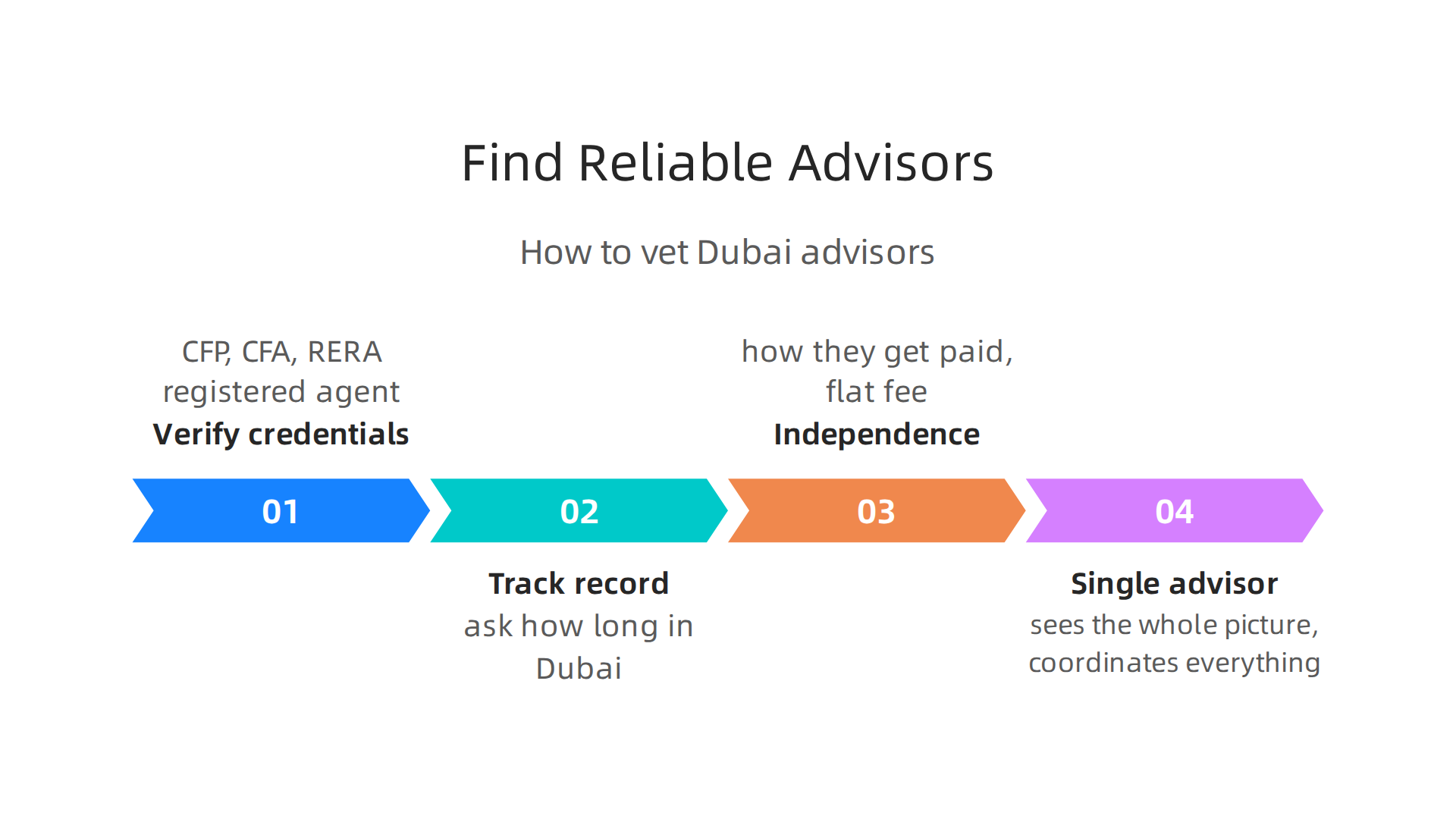
Start with credentials. Look for advisors who hold recognized certifications. The most trusted ones include the CFP (Certified Financial Planner) mark and the CFA (Chartered Financial Analyst) designation. For real estate specifically, check if they are registered with RERA, the Real Estate Regulatory Authority in Dubai. A RERA registered agent has passed official exams and follows ethical rules. Some advisors also offer a fiduciary like standard of care. That means they are legally required to put your needs first. A guide on the latest UAE Golden Visa 2026 requirements notes that working with verified professionals is essential when dealing with large property investments and residency applications.
Check their track record and independence. Ask how long they have worked in Dubai. Ask for client references. And ask how they get paid. Do they earn a flat fee, a percentage of assets, or commissions from product sales? Fee only advisors tend to give more objective advice. If an advisor keeps pushing one specific investment product, that is a red flag.
Look for one advisor who sees the whole picture. Many expats end up with three separate people: a real estate agent for buying property, a tax accountant for filing returns, and a wealth manager for investments. That creates gaps and conflicts. A single trusted advisor who coordinates real estate, tax, and wealth management can simplify everything.

They help you avoid mistakes like buying a property that hurts your tax situation or investing in a way that does not match your residency goals. You can learn more about this approach by reading about how to choose a fiduciary financial advisor in Dubai who takes a holistic view.
Taking time to verify credentials and independence now saves you from costly mistakes later. If you are looking for a place to start, connect with a trusted local professional. FREE Dubai Real Estate Consultation A one on one conversation can help you decide what is right for your situation.
Summary
This guide explains how to plan your personal finances around buying property in Dubai so your choices support long‑term wealth instead of creating fragmented risk. It walks through practical steps: assessing net worth, cash flow, liquidity and currency exposure; deciding how much of your portfolio should sit in real estate; and picking the right type of property and location for income or growth. The article also covers Dubai‑specific issues — freehold vs leasehold, off‑plan risks, visa rules including the Golden Visa, and cross‑border tax reporting — plus ways to manage vacancy, currency and market risks. You’ll learn simple rules of thumb for allocation, how to stress‑test scenarios, rental strategies to boost net yield, and how to find a trusted, credentialed advisor who coordinates tax, property and investment planning. By the end you’ll be able to build a unified strategy, ask the right due‑diligence questions, and know when to bring in a chartered financial advisor.